Heated vs Ventilated Seat Covers: Climate Control That Actually Works
You're sitting in your truck in July. Outside, it's 95°F. The sun has turned your black leather seats into a skillet. Your back is drenched with sweat, the leather is sticky, and you're considering parking in the shade just to sit down. Now imagine the opposite: December morning, 20°F, and your OEM cloth seats feel like ice. You want heat, but your truck's built-in heated seats — if it has them — only work when the engine runs.
This is where aftermarket heated and ventilated seat covers become genuinely useful, not just a luxury upgrade. But the market is crowded with claims that don't hold up to real use. Some "ventilated" covers are just mesh with no actual cooling function. Some "heated" covers are temperature traps that make you hotter than stock seats.
This guide breaks down how heated and ventilated seat covers actually work, which technologies deliver real performance, and whether they're worth the investment for your vehicle and climate.
How Heated Seat Covers Work
Active heating (electric): Electric heated seat covers use resistance heating — the same principle as a space heater or electric blanket. A low-voltage heating pad (typically 12V or 24V for vehicles) is woven into or attached to the fabric. When powered on, the resistance element generates heat that warms the seated area.
Key specs that matter:
- Wattage: Higher wattage = faster heating. 40–60 watts is typical for a full seat. 100+ watts will heat very quickly but draws more power.
- Control options: Manual (on/off switch), dial (adjustable temperature), or smart (multiple settings). Smart controls are increasingly common and worth the cost difference.
- Power source: 12V DC (vehicle battery) is standard. Some covers also offer USB or plug-in AC (home/office use).
- Safety rating: Look for overheat protection and automatic shut-off after 30–60 minutes of continuous use (prevents battery drain and fire risk).
- Installation: Some require wiring to the vehicle's electrical system. Others plug into the 12V lighter socket (simpler, less power available).
How Ventilated Seat Covers Work
Here's where marketing gets intentionally vague. "Ventilated" doesn't always mean active cooling. There are several approaches, from passive to genuinely effective:
Passive ventilation (airflow only): This is mesh fabric with openings that allow air circulation. No motors, no active cooling. It reduces heat accumulation by letting air pass through instead of trapping it against your body. It cools by airflow, not by removing heat from the seat — meaning it works better with your truck's AC fan or when the windows are down.
Active ventilation (air circulation): Some premium covers use small fans built into the seat back or cushion. These fans push cool air through the fabric toward your body. More effective than passive, but requires power and can be noisy.
Water-cooled ventilation (rare): High-end aftermarket systems use circulating coolant (similar to a car's cooling system) to actively remove heat from the seat. This is expensive and typically only found on ultra-premium restorations or luxury vehicles. Not relevant for tactical seat cover users.
Gel or phase-change padding (passive, temperature-buffering): Some covers use cooling gel or phase-change materials embedded in the padding. These absorb heat and slowly release it, keeping seats cooler longer. Not as effective as active cooling but more reliable than passive mesh.
Heated Covers: Real-World Performance
What they actually do:
- Warm cold seats in winter — useful when parked overnight or during pre-dawn starts
- Provide therapeutic warmth for sore backs during long drives
- Reduce the need to run your truck's engine to get heat (fuel savings in short trips)
- Work independently of your truck's built-in system (add coverage to seats that don't have heated functions)
What they don't:
- Generate enough heat to keep you warm in extreme cold without your truck's primary heating system
- Work effectively if your truck's electrical system can't supply stable 12V power
- Function for extended periods on battery alone (they drain battery if the engine isn't running)
Best for: Cold-climate users (snow, ice, extended winter exposure) who want quicker warmth when starting the truck, or those with older vehicles that lack built-in heated seats.
Ventilated Covers: Real-World Performance
Passive mesh ventilation:
- What it does: Reduces heat buildup by allowing air to pass through. Works best when air is actively flowing (AC vent directed at seat, windows down, fan mode on).
- Real-world cooling: Maybe 5–8°F cooler than a solid cover with the same air circulation. Not dramatic, but noticeable on hot days.
- Downside: Loses effectiveness in still air (parked with windows up, no AC running).
Active fan ventilation:
- What it does: Pushes cool air directly at your back, independent of truck airflow. More effective in still conditions.
- Real-world cooling: 10–15°F cooler than a solid cover, even with AC off. Noticeable and meaningful in extreme heat.
- Downside: Requires power, can be audible, adds complexity.
Gel or phase-change padding:
- What it does: Absorbs heat from your body and releases it slowly. Keeps the seat surface cool longer than unpadded fabric.
- Real-world cooling: Subtle but sustained — your initial contact feels cool, even if the effect diminishes over time.
- Downside: Requires a cool environment to "recharge" (not as effective in a hot vehicle).
Best for: Hot-climate users (desert, Southwest, prolonged summer driving) where long-term comfort matters more than dramatic cooling.
Heated + Ventilated: The Best of Both?
Some premium covers combine both heating and ventilation. The theory: heat in winter, cooling in summer. The reality depends on build quality and how well the heating elements are integrated without blocking airflow.
Good dual-function covers: Heating and ventilation in separate systems (heating elements don't block mesh). You can use them independently or even together for year-round comfort.
Poor dual-function covers: Heating pads placed directly under ventilation mesh, which defeats the purpose of the mesh. Ventilation becomes ineffective because airflow is blocked.
Key Brands and Their Climate Control Options
Bartact (Tactical with No Built-In Climate)
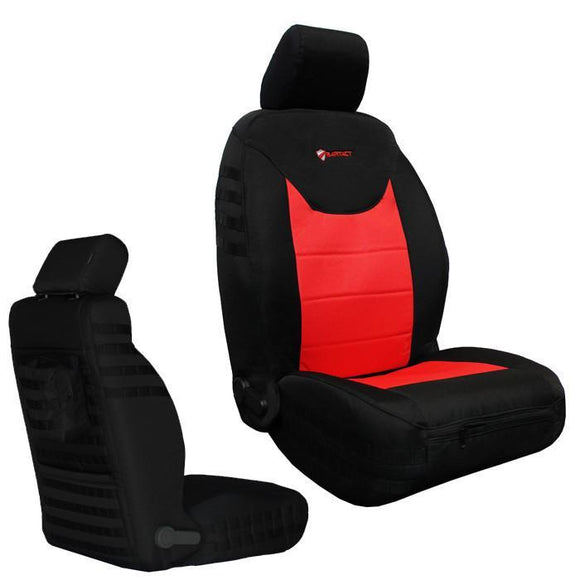
UV-protected polyester and 1000D Cordura nylon option with waterproof polyurethane backing, real MOLLE System with PALS Webbing, true Bar Tack stitching, and made in USA with Berry Amendment compliance. Bartact doesn't offer integrated heating or ventilation in their standard seat covers. If you need climate control, you'd need to use aftermarket heated/ventilated pads under a Bartact cover, or select a different brand.
The advantage of Bartact: they focus on durability and tactical storage, which is ideal for work environments where climate control is secondary.
Smittybilt G.E.A.R. (No Built-In Climate)
Smittybilt's G.E.A.R. covers offer 600D polyester with PALS-style webbing but don't include heating or ventilation. Like Bartact, Smittybilt prioritizes durability and storage over temperature management.
Wet Okole (Ventilated Options Available)
Wet Okole neoprene covers offer passive ventilation through strategic perforation. The neoprene is water-resistant, and the perforations allow some air circulation when air is flowing (AC on, windows down). Not active cooling, but better than a solid seal. Neoprene also has moderate passive thermal properties — it stays cooler longer than heavy polyester in direct sun, though it doesn't provide dramatic cooling.
Coverking SeatSaver (Heated Option Available)
Covercraft's SeatSaver canvas covers can be paired with aftermarket heated inserts. Some aftermarket vendors sell heated pads designed to work under canvas covers. The combination gives you durable Carhartt canvas with optional heating for winter use.
Rightline Gear (Heated + Ventilated)
Rightline Gear offers dedicated heated and ventilated seat covers with built-in 12V heating elements and fan-based ventilation. These are designed as all-in-one solutions combining both technologies. The heating works well; ventilation is fan-based and effective when powered on. These are higher-end solutions (typically $300–$600 per seat) and require wiring integration.
Check Rightline Gear on Amazon →
Katzkin Leather (Premium Heated + Ventilated)
Katzkin offers custom leather seat covers with integrated heating and ventilation options. These are high-end, custom-fitted solutions (typically $1500–$3000+ total installation) that combine aesthetic upgrades with climate control. Best for owners willing to invest in a comprehensive interior upgrade, not as an aftermarket band-aid solution.
Heated vs Ventilated: Which Should You Choose?
| Climate / Use Case | Heated? | Ventilated? | Best Option |
|---|---|---|---|
| Winter-dominant climate (cold mornings, frequent ice) | Yes | No | Heated cover or heated insert under tactical cover |
| Extreme summer heat (90°F+, extended parked time) | No | Yes | Active ventilated (fan-based) or mesh tactical cover with AC circulation |
| Mild four-season climate (occasional extremes) | Maybe | Maybe | Dual-function (heated + ventilated) if budget allows; otherwise focus on durability |
| Desert or Southwest (intense sun, hot days) | No | Yes | Ventilated cover; prioritize light colors and airflow |
| Work truck (durability first) | No | No | Tactical cover (Bartact, Smittybilt) without climate features; durability matters more |
| Overlanding (variable climate, long days in vehicle) | Maybe | Yes | Ventilated tactical cover; consider heated for cold camps |
Factors That Affect Heating/Cooling Performance
Seat Cover Color
For cooling: Light colors (tan, coyote, white) reflect more heat than dark colors. The difference is real — a light-colored seat in the sun can be 10–15°F cooler than black under identical conditions.
For heating: Dark colors absorb more heat from the sun, which helps in winter. Not a huge factor because you're relying on the heating element, not solar absorption.
Vehicle Type
Trucks and SUVs: Larger seating area, typically more power draw for active systems. Heated covers work better in trucks with 12V stable power (e.g., trucks with battery isolators for auxiliary systems).
Compact cars: Less power available in the 12V system for aftermarket climate covers. You may need to upgrade your electrical system to support active heating/cooling.
Sun Exposure
Passive cooling: Works better with active airflow (AC or open windows). On a parked truck in still air, passive mesh ventilation is ineffective.
Active cooling (fans): Works independently of airflow but consumes more power.
Installation Quality
Poorly installed heated or ventilated covers lose effectiveness because:
- Heating elements don't make uniform contact with the seat surface
- Ventilation holes are blocked by improper fit
- Wiring is loose or intermittent, reducing power delivery
Budget time and possibly professional installation if you choose a cover with built-in climate features.
Do You Actually Need Heated or Ventilated Covers?
You probably need heated if:
- You live in a climate with regular winter exposure (below freezing for weeks at a time)
- You do early morning starts without idling the engine (cold seats are painful)
- You have back pain that responds to heat therapy
- Your truck lacks factory heated seats and you spend long hours driving in winter
You probably need ventilated if:
- You live in the Southwest, desert, or intense summer heat (90°F+ for weeks)
- Your truck gets parked in full sun regularly and overheats quickly
- You spend extended time seated (long drives, camping, guide work)
- Your truck already has AC, and you want seats that work with it, not against it
You probably don't need either if:
- You live in a mild climate with minimal temperature extremes
- Your truck has factory heated/cooled seats that work well
- You prioritize durability, MOLLE storage, or tactical features over comfort upgrades
- Your budget is limited and you need to choose between climate control and tactical functionality
Integration with Tactical Covers
If you want a tactical seat cover (Bartact, Smittybilt) but also want climate control, you have options:
- Heated pad under the cover: Purchase a basic 12V heated seat pad (budget option) and place it under your tactical cover. Some covers have enough flexibility to accommodate padding underneath.
- Ventilation via mesh or perforation: Choose a tactical cover in a light color and with a looser weave (if available) to allow passive airflow. Pair it with your truck's AC for active cooling.
- Switch priorities: Accept that a tactical cover prioritizes durability and storage over climate; use a non-tactical ventilated or heated cover instead.
The reality: most tactical users don't prioritize climate control because they're using the seats for work, not comfort. But if you need both, the first option (heated pad under a tactical cover) is the most practical compromise.
Find heated, ventilated, or tactical seat covers for your vehicle
Find Covers For Your Vehicle → Why Tactical? →Related reading: Waterproof vs Water-Resistant · UV Damage and Seat Covers · Seat Cover Maintenance Guide · Best Seat Covers for Work Trucks