UV Damage and Your Seats: Why Material Matters
Park your truck in the sun for a few summers and the evidence is hard to miss — cracked dash, faded upholstery, seats that feel like they've aged a decade. UV radiation is relentless, and it doesn't just bleach color out of fabric. It breaks down the molecular structure of materials, turning flexible foam brittle, weakening stitching, and causing lower-quality fabrics to shed fibers and lose tensile strength long before they look worn out.
If you're shopping for seat covers and UV protection is on your checklist — especially if you live in the Southwest, work outdoors, or regularly leave your truck in the sun — the material story matters a lot more than most product listings let on.
What UV Actually Does to Your Seats
Ultraviolet radiation breaks chemical bonds. That's the short version. For vehicle interiors, it plays out in a few specific ways:
- Leather and vinyl: UV degrades the oils and plasticizers that keep these materials supple. The result is cracking, peeling, and surface hardening — usually starting with the areas that get the most direct sun (seat bolsters facing the window, headrests).
- Foam: Seat foam is typically polyurethane-based. UV exposure oxidizes polyurethane, causing it to yellow and become brittle. This is most visible in armrests and headliners but happens in seat cushions too, especially on vehicles without tinted windows.
- Fabric upholstery: UV breaks down dye molecules first (fading), then starts degrading the fiber structure itself. Cheaper polyesters with no UV stabilization can become noticeably weaker within a few seasons of regular sun exposure.
- Stitching: Thread — especially polyester thread with no UV treatment — loses tensile strength with prolonged UV exposure. Seams that looked fine visually start failing under stress before the fabric shows obvious wear.
A seat cover adds a physical layer between your OEM upholstery and direct UV exposure, which helps. But the cover itself is now absorbing that radiation. Whether the cover material degrades fast or holds up for years comes down to what it's made of and whether it has UV stabilization built in.
How Different Materials Handle UV
UV-Protected Polyester
Standard polyester has decent inherent UV resistance compared to natural fibers, but it degrades with prolonged exposure — fading first, then losing strength. UV-protected polyester has chemical stabilizers (typically HALS — Hindered Amine Light Stabilizers) added during production that absorb UV energy and prevent it from breaking down the polymer chains. The difference in lifespan between untreated and UV-treated polyester in high-sun environments is significant.
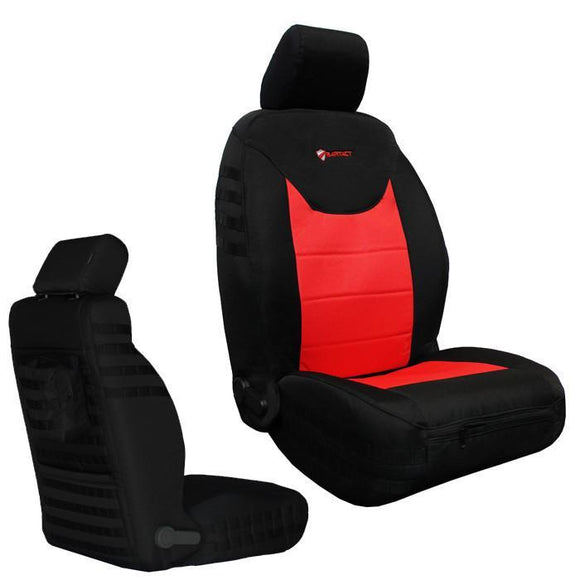
Bartact's seat covers use UV-protected polyester as the base fabric — not just standard polyester. That distinction matters if your truck sits outside in Phoenix or San Diego for 10+ hours a day.
1000D Cordura Nylon
Cordura nylon has strong inherent UV resistance — nylon's chemical structure absorbs UV energy more effectively than most polyesters without additional treatment. The 1000D weight (denier) means thicker, denser fiber, which provides more material for UV to work through before reaching the backing. In high-UV environments, the Cordura option on Bartact covers offers a meaningful upgrade in long-term durability vs. standard polyester face fabric.
It's worth noting: the 1000D Cordura nylon is an option on Bartact products, not standard across every SKU. If UV durability is your priority, it's worth specifying.
Neoprene
Neoprene has limited UV resistance on its own — it'll fade and eventually harden with extended sun exposure, though it takes longer than untreated fabrics. The bigger issue is heat retention: neoprene absorbs and holds heat, so in high-UV (and high-temperature) environments it gets very hot. Some neoprene covers have UV-resistant top coatings, but it's not universal. Check the spec sheet.
600D Standard Polyester
Common in budget tactical and off-road covers. Without UV treatment, 600D polyester fades noticeably within 2-3 seasons of consistent sun exposure and starts losing strength after that. It's fine for vehicles that are garaged or spend most of their time in lower-UV climates. For trucks sitting outside in the desert year-round, it's a weak point.
Ballistic Nylon
Similar UV profile to Cordura — good inherent resistance due to nylon chemistry. The heavy denier weight (1000D+) provides additional buffer. Solid choice for UV environments, though typically without the waterproof PU backing that polyester covers include.
Material UV Resistance at a Glance
| Material | UV Resistance | Notes |
|---|---|---|
| UV-protected polyester | High | HALS stabilizers added — specifically engineered for sun exposure |
| 1000D Cordura nylon (option) | High | Strong inherent UV resistance + dense weave provides physical buffer |
| Standard polyester (no UV treatment) | Moderate | Fades within 2-3 seasons; loses strength over time in high-UV climates |
| 600D polyester (budget covers) | Low–Moderate | Acceptable in shaded/garaged use; struggles in constant sun exposure |
| Neoprene | Moderate | Fades over time; heat retention in sun is a comfort issue |
| Ballistic nylon | High | Good inherent UV resistance; usually no waterproof backing |
What the Backing Does (and Doesn't Do)
The waterproof polyurethane backing on quality seat covers is primarily a moisture barrier — it keeps liquids from soaking through to your OEM foam. But it also adds a secondary UV-blocking layer. Light that passes through the face fabric hits the PU backing before it reaches your seat. Over time, the backing absorbs UV too and can yellow or stiffen, but it adds to total UV protection for the underlying seat.
Covers without a PU backing — some neoprene, some ballistic nylon products — pass more UV through to the seat foam over time. Not a huge factor for covers that fit snugly, but worth understanding.
The Real-World Case for UV-Protected Fabric
A few scenarios where the UV spec is worth prioritizing:
- Southwest and sunbelt states: Arizona, California, Nevada, New Mexico, Texas — UV index regularly hits 11+ in summer. Covers in these climates see 2-3x the UV load of northern states. Material choice matters more here than almost anywhere.
- Vehicles without tinted windows: Factory window tint blocks some UV but not all. If you're running clear glass or a older vehicle without tint, the cabin UV load is higher.
- Trucks that park outside: Garaged vehicles stay cooler and see far less total UV exposure. If your truck lives outside year-round, calculate that against the cover's expected lifespan.
- Light-colored covers: Lighter colors show fading more quickly. UV-protected fabric in tan or coyote holds color much better than untreated fabric in the same shade.
Protecting Your Seats Beyond the Cover
A UV-resistant seat cover is your first line of defense, but it works better with a few supporting moves:
- Window tint: Quality ceramic tint blocks 99%+ of UV at the glass — the single most effective protection for your entire interior, seats included.
- Sunshade for the windshield: Blocks direct sun from the dash and reduces cabin temperature, which extends the life of everything in the interior.
- Park in shade when possible: Obvious, but the cumulative difference over years is meaningful.
- Wipe down covers after extended sun exposure: Heat accelerates chemical degradation. Letting covers cool down and wiping off any surface dust keeps them in better shape longer.
The Bottom Line
If UV protection matters for your use case, the material spec on your seat cover isn't just marketing — it's a real differentiator in how long the cover performs and how well it protects what's underneath. UV-protected polyester and the 1000D Cordura nylon option (available on Bartact covers) are your best bets for high-sun environments. Budget 600D polyester covers will work, but they'll fade and weaken faster.
The combination that holds up best in prolonged sun exposure: UV-treated face fabric + waterproof PU backing + UV-stabilized stitching. Bartact's Tactical line checks all three boxes, with the Cordura upgrade option for maximum durability.
Shop Bartact Tactical Seat Covers →
Find UV-resistant seat covers for your exact vehicle
Search by Year, Make & Model → Why Tactical Covers? →Related reading: Neoprene vs. Cordura: Which Material is Right for You? · Are Tactical Seat Covers Worth It? · 5 Mistakes People Make Buying Seat Covers Online
Disclosure: TacticalSeats.com contains affiliate links. We may earn a commission on qualifying purchases at no extra cost to you.